
Google doesn’t update its algorithm to “change the game.” It updates it to reveal what the game really is. Every shift quietly rewrites the rules of visibility, deciding which brands get discovered and which ones fade into the background.
That’s why Google’s December 2025 Core Update matters. It is not a single tweak. It is a broad re-evaluation of what Google now trusts, rewards, and demotes across search results. In the pages ahead, we’ll decode the patterns behind the volatility and turn uncertainty into a clear SEO action plan, grounded in data and technical clarity.
When did it start, and how long does it take?
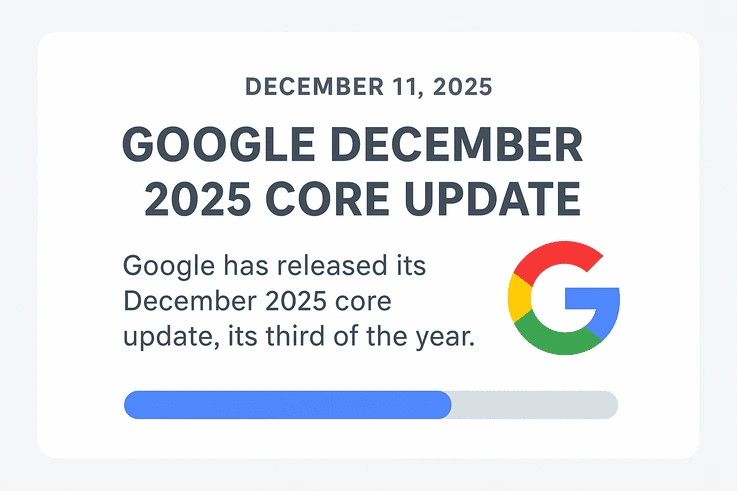
Google’s December 2025 Core Update began on December 11, 2025 at 09:25 (US/Pacific), and Google notes the rollout may take up to three weeks to complete. During this rollout window, ranking and traffic volatility is normal, so it’s best to evaluate changes only after the update finishes and the results stabilize.
What is Google’s December 2025 Core Update?
Google’s December 2025 Core Update is a broad update to Google’s core ranking systems that can change search results across many topics and industries. Unlike targeted updates that focus on a single issue, a core update re-assesses which pages best satisfy search intent and quality expectations, which is why visibility can rise or drop even if you didn’t change anything on your site. It is not a manual penalty; it is Google adjusting how it evaluates content overall.
Why do rankings fluctuate during Google’s December 2025 Core Update?
Ranking swings are normal during Google’s Core Update because core updates roll out in phases and adjust how Google’s ranking systems evaluate relevance and quality across the web. As the new signals and weighting are applied progressively, your pages can move up or down more than once before the rollout finishes and results stabilize. Since Google indicates the rollout may take up to three weeks, it’s best to avoid rushed conclusions and review performance after the update completes.
What should you do if your rankings drop after Google’s December 2025 Core Update?
If you see a drop after Google’s December 2025 Core Update, start by confirming the rollout status in Google’s Search Status Dashboard and avoid making rushed site-wide changes while results are still volatile. Next, rule out technical causes (indexing, robots, no index tags, server errors), then isolate the impact in Google Search Console by comparing affected pages and queries before vs. after the update, focusing on where the losses are concentrated.
From there, prioritize upgrading your most important pages by matching search intent more precisely, improving content depth and clarity, and strengthening trust signals (accurate sourcing, author expertise, transparent “about” and editorial standards). Google also recommends waiting until the update completes, then giving it at least a full week before doing a final performance assessment.
How long does recovery usually take after a Google Core Update?
Recovery after a Google Core Update can vary widely. Google’s guidance is that improvements may show results in a few days, but it can take several months for Google’s systems to learn and confirm site-wide quality changes, and if you still see no impact after a few months, you may need to wait until the next core update for stronger reassessment.
As a baseline, Google also recommends waiting at least one full week after the core update finishes rolling out before doing your final performance analysis in Search Console.
Which page types are most affected by Google’s December 2025 Core Update?
Here are the page types that most often see noticeable wins or losses after Google Core Updates (because Google is broadly re-evaluating content quality, relevance, and trust signals):
- Thin or low-value pages: pages that don’t add much beyond what’s already ranking, or don’t fully answer the query.
- Outdated / not maintained content: pages where accuracy, freshness, or completeness no longer matches what searchers expect.
- Intent-mismatch pages: pages targeting keywords but failing to satisfy the real search intent (informational vs transactional, comparison vs how-to, etc.).
- YMYL content (health, finance, legal, safety): pages in “Your Money or Your Life” areas tend to be more sensitive because trust and reliability matter more.
- Pages with weak trust signals: unclear authorship, no editorial standards, no sourcing for important claims, or poor transparency about who is behind the site.
- Scaled or templated pages that feel mass-produced: large sets of similar pages that don’t provide distinct, helpful value per page (even if they’re indexed).
Did Google’s December 2025 Core Update penalize my site, or is it an algorithmic re-ranking?
In most cases, it’s an algorithmic re-ranking, not a penalty. After Google’s December 2025 Core Update, drops in traffic usually happen because Google is re-evaluating relevance and quality signals across the web, which can reshuffle results even if you made no changes. A true penalty is typically a separate process called a Manual Action, and Google would normally report it inside Google Search Console (under Manual Actions). If no manual action is reported, you should treat the decline as a signal to improve intent match, content usefulness, and trust signals rather than as a “punishment.”
What did Google change in December 2025 that matters most for SEO?
Google’s December 2025 Core Update launched (Dec 11, 2025). Google confirmed the release on the Google Search Status Dashboard, noting the rollout may take up to three weeks, which is why ranking volatility is expected during the rollout window.
Google Search Console introduced weekly and monthly performance views (Dec 10, 2025). This helps SEOs spot real trends around a core update by smoothing daily noise and improving analysis of clicks, impressions, CTR, and average position over time.
Google updated its “Core Updates” guidance to emphasize tracking rollout completion. The documentation specifically advises confirming the update has finished via the Search Status Dashboard before making conclusions and comparing performance.
Search documentation clarified “smaller core updates” can happen continuously (Dec 15, 2025). This matters because improvements can sometimes be reflected without waiting for the next major core update, reinforcing the value of ongoing content quality work.
JavaScript SEO clarifications were published (Dec 17–18, 2025). Google clarified canonicalization best practices for JavaScript and explained how Googlebot processes JavaScript on non-200 HTTP status codes, both of which can affect indexing, rendering, and stable rankings for JS-heavy sites.
When should you bring in an SEO specialist or an expert team after a Google core update?
You should consider an SEO specialist or a dedicated team when the impact is material and persistent (for example, a sustained drop in non-brand traffic, leads, or revenue), when visibility losses are spread across many key pages, or when you can’t clearly isolate whether the cause is content quality, intent mismatch, technical SEO, or a mix of all three.
It becomes even more important if your site operates in competitive or high-trust categories (e.g., health, finance, legal), if you’re dealing with complex setups (international SEO, migrations, JavaScript rendering, large-scale templates), or if internal fixes haven’t produced measurable improvement after the rollout fully settles. In these situations, an external audit can help you move faster by mapping losses to specific page groups, prioritizing fixes by business impact, and building a recovery roadmap that aligns content, technical performance, and trust signals.
Many brands also choose to get a second opinion from specialists who work with core-update volatility regularly, and a quick diagnostic review from a team like SEO Eplus can be a practical way to validate assumptions and avoid costly trial-and-error.
👏🏻👏🏻👏🏻