
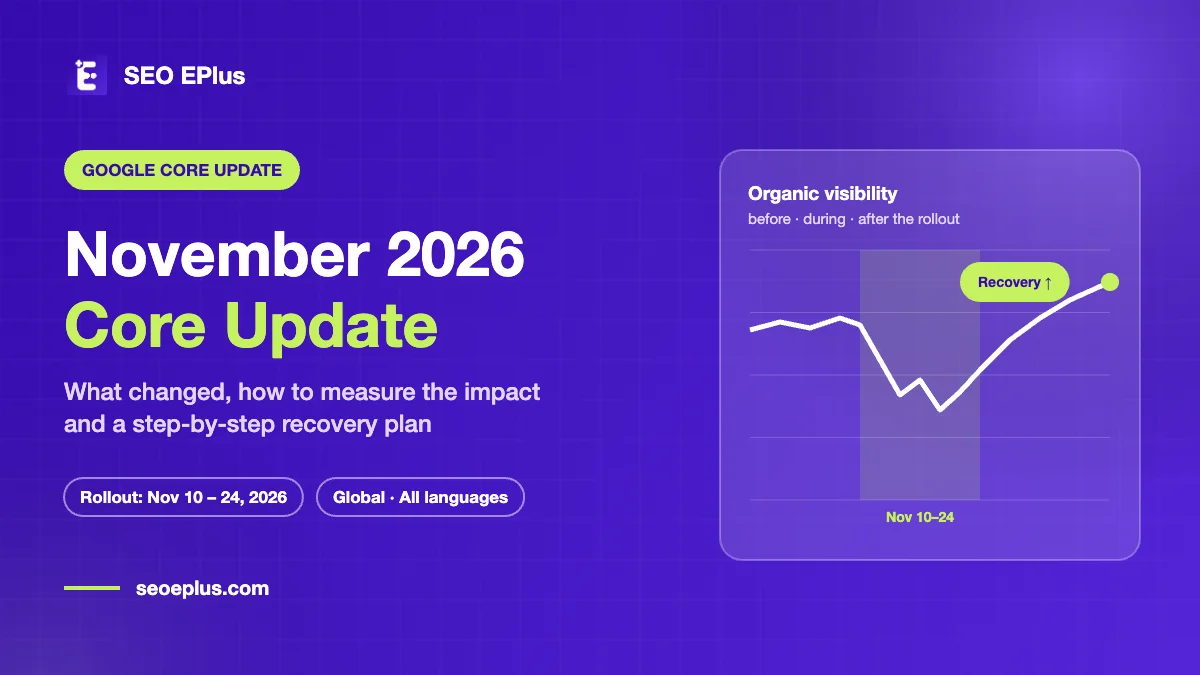
The Google November 2026 core update started on November 10, 2026 and finished rolling out on November 24, 2026, according to Google’s Search Status Dashboard. It is a broad, global update that applies to all languages, and Google did not name any specific target. If your traffic moved during those two weeks, the short answer is this: wait one full week after completion, compare clean date ranges in Search Console, and only fix pages with large, sustained drops. Do not panic-edit pages that slipped one or two positions.
There is a second reason to act carefully right now. On the same day the November rollout ended, Google preannounced a December 2026 core update. So most sites will face two core updates in about six weeks. In this guide, we explain what changed, what Google actually said, how to measure the impact without fooling yourself, and a step-by-step recovery plan that also prepares you for December.
We wrote this for business owners and marketing teams, with practical notes for sites in Qatar, the UAE, Saudi Arabia and the wider Gulf, where November and December are busy, seasonal months.
Table of Contents
- Quick Facts: The November 2026 Core Update at a Glance
- What Changed in the November 2026 Core Update?
- How the November 2026 Core Update Fits the 2026 Timeline?
- The December 2026 Core Update Is Already Announced
- How to Measure the Impact Without Fooling Yourself
- How to Recover From the November 2026 Core Update
- Mistakes to Avoid After the November 2026 Core Update
- What About AI Overviews and AI Mode?
- What Gulf Businesses Should Watch
- Key Takeaways
- FAQ
Quick Facts: The November 2026 Core Update at a Glance
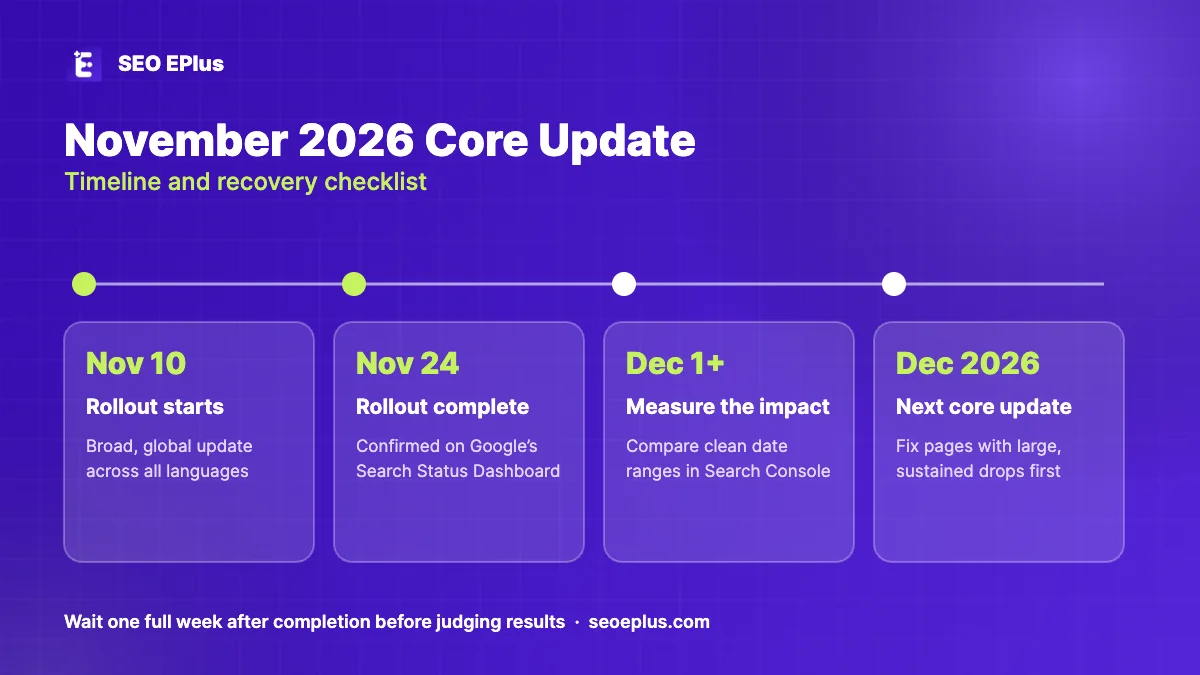
Here are the confirmed facts, taken from Google’s own dashboard. Everything else you read online about the November 2026 core update is analysis, not official information.
| Item | Detail |
|---|---|
| Update name | November 2026 core update |
| Type | Broad core update (not a spam update) |
| Start | November 10, 2026, 10:06 a.m. US Pacific time |
| Rollout complete | November 24, 2026, 6:03 a.m. US Pacific time |
| Duration | 13 days, 20 hours (per the dashboard) |
| Scope | Global, all languages |
| Stated target | None named. Google called it a regular update to surface relevant, satisfying content |
| Next update | December 2026 core update, preannounced on November 24, 2026 |
Google also posted about the November 2026 core update on its Search Central LinkedIn page. As Search Engine Journal reported, Google described it as a regular update meant to better surface relevant, satisfying content from all types of sites, which is the same wording it used in March 2026.
What Changed in the November 2026 Core Update?
Google did not publish a list of changes, and it rarely does for core updates. What we know is the purpose: core updates are broad changes to Google’s ranking systems that reassess how well pages answer searchers, across the whole web.
Google’s core updates documentation explains that these changes “don’t target specific sites or individual web pages.” Instead, Google reassesses content as the web changes. A page that drops is not necessarily bad. It may simply have been overtaken by pages that now look more helpful for that query.
Why Google keeps the details vague
Core updates adjust many signals at once. Because nothing is aimed at one tactic, there is no single switch to flip back. This is why recovery advice always comes back to the same theme: content that is helpful, reliable and written for people first.
What industry trackers observed
Rank-tracking tools reported volatility during the rollout, but no reliable public data has yet shown a clear winner or loser pattern for the November 2026 core update. For context, PPC Land reported that after the March 2026 core update, aggregators, directories and comparison sites took some of the heaviest losses, based on third-party ranking data. Treat that as background, not proof of what happened in November.
When we review a site after an update, we look at the pattern on that site, not the headlines. Two sites in the same niche can move in opposite directions in the same update.
How the November 2026 Core Update Fits the 2026 Timeline?
The November 2026 core update was the third broad core update of 2026. The ranking history on the Search Status Dashboard shows a busy year, with spam updates in between.
| Update | Start date | Duration |
|---|---|---|
| February 2026 Discover update | Feb 5, 2026 | 21 days, 17 hours |
| March 2026 spam update | Mar 24, 2026 | 19 hours, 30 minutes |
| March 2026 core update | Mar 27, 2026 | 12 days, 4 hours |
| May 2026 core update | May 21, 2026 | 11 days, 21 hours |
| June 2026 spam update | Jun 24, 2026 | 2 days, 1 hour |
| August 2026 spam update | Aug 18, 2026 | 2 days, 16 hours |
| September 2026 spam update | Sep 24, 2026 | 13 days, 16 hours |
| November 2026 core update | Nov 10, 2026 | 13 days, 20 hours |
| December 2026 core update | Preannounced Nov 24, 2026 | Scheduled for December |
Many sites saw ranking shifts overlap with other updates, especially in late 2025. If you want to compare patterns, our analysis of the December 2025 core update winners and losers and our notes on unconfirmed Google ranking volatility in January 2026 show how easy it is to blame the wrong update.
The lesson from the timeline is simple. Updates are frequent. If your SEO plan only reacts after every update, you will always be behind. Steady quality work is what holds rankings through them.
The December 2026 Core Update Is Already Announced
On November 24, 2026, about an hour after the November rollout was marked complete, Google preannounced the December 2026 core update. This is unusual. Google normally announces core updates on the day they start.
According to the dashboard, the December update focuses on improvements to how Google’s systems understand and rank relevant content, including for longer and more complex questions. It also aims to improve personalized results for people who have personalization turned on. It applies to all locations and languages, and Google says its general core update guidance applies.
What this means for you
- Your November data window is short. You may only get two or three clean weeks before December begins. Start your analysis now.
- Long, complex questions matter more. Pages that answer detailed, multi-part questions clearly, with real depth, are likely to be in focus.
- Do not stack big changes. If you rewrite large parts of your site right before December, you will not know which update or which change caused what.
- Personalization adds noise. Rankings you see in your own browser may differ even more from what customers see. Rely on Search Console data, not manual checks.
How to Measure the Impact Without Fooling Yourself
Measure first, then act. Google itself recommends waiting at least one full week after a core update completes before analyzing your site in Search Console. For the November 2026 core update, that means waiting until at least December 1, 2026.
Here is the measurement process we use. It follows the steps in Google’s core updates documentation, with a few practical additions.
- Confirm the dates. Use the official incident page: start November 10, end November 24.
- Pick clean comparison windows. Compare a full week after completion (for example, November 25 to December 1) with a full week before the start (for example, November 2 to November 8). Use the same days of the week.
- Review top pages and top queries. In the Search Console Performance report, sort by clicks and compare average position for each page.
- Classify the drop. Google’s own example: a move from position 2 to 4 is a small drop and needs no drastic action. A move from position 4 to 29 is a large drop that needs a deeper assessment.
- Split by search type. Check Web, Image, Video and News separately. A drop in one search type can hide inside the total.
- Separate demand from ranking. If impressions fell but average position held, the cause is probably seasonal demand, not the November 2026 core update.
- Annotate everything. Note the November start and end dates, and the December update when it begins, in your analytics and reports.
Watch out for seasonality
November is not a normal month. As Search Engine Journal and Semrush both pointed out, many retail sites will be comparing holiday-season traffic against normal weeks. In the Gulf, White Friday sales, Qatar National Day on December 18 and UAE National Day on December 2 all shift search demand. A traffic spike or dip during these weeks may have nothing to do with Google’s update.
Watch out for reporting glitches
Semrush noted that Google confirmed a logging issue that lowered some impressions in a Search Console generative AI report between November 9 and 11, which overlaps the first days of the rollout. If you see an odd dip on those exact dates, check for known reporting issues before assuming a ranking loss.
How to Recover From the November 2026 Core Update
Recovery means improving the pages that lost the most, so they become the best answer for the searcher. There is no technical trick that reverses a core update drop.
If you saw a large, sustained drop, Google recommends reviewing your site against its helpful content self-assessment questions. Here is how we turn that advice into an action plan.
Step 1: List the pages that lost the most
Export page-level data from Search Console for both date windows. Sort by the biggest loss in clicks. Usually, a small group of pages explains most of the drop. Start there.
Step 2: Search the queries yourself
For each affected page, search its main queries and look at the pages that now rank above you. Ask honestly: do they answer the question faster, in more depth, or with more first-hand experience? Google’s documentation says there may be other pages on the web doing a better job of helping the searcher. Your goal is to find out why.
Step 3: Run a content quality review
Use the self-assessment questions as a checklist. The most useful ones in practice are:
- Does the content provide original information, research or analysis?
- Does it give a complete, substantial answer to the topic?
- Does it show first-hand expertise and experience, with clear authorship?
- Would a reader leave satisfied, or need to search again?
- Was the page created mainly to attract search visits, or to help a real audience?
Experience and trust signals matter here. Our AI SEO audit checklist with 50+ points covers the content, technical and trust checks we run when a site loses visibility.
Step 4: Rule out technical problems
A core update is often blamed for problems that are actually technical. Before rewriting content, check indexing, crawl errors, broken internal links, slow mobile pages and accidental noindex tags. A broken XML sitemap or a page blocked from indexing can look exactly like an update drop in your traffic graph.
Step 5: Improve, do not just edit
Make changes that help users and last. That may mean restructuring a page so the answer comes first, adding real examples, updating outdated information, merging thin pages that compete with each other, or adding expert input. Google warns against quick fixes, such as removing a page element because you heard it was bad for SEO.
Step 6: Be patient and track
Google says some improvements can show within days, but it can take several months for its systems to confirm that a site as a whole is now producing helpful content. Sometimes recovery only appears with the next core update. With December already announced, steady improvements made now have a real chance to be reflected soon, but there is no guarantee.
If you do not have the time or in-house team for this, our SEO services for businesses in Qatar and the Gulf include core update impact analysis, content audits and a recovery roadmap.
Mistakes to Avoid After the November 2026 Core Update
Most damage after a core update comes from rushed reactions, not from the update itself. Avoid these common mistakes.
| Mistake | Why it hurts | Do this instead |
|---|---|---|
| Changing pages during the rollout | Rankings move daily, so you react to noise | Wait one full week after completion |
| Editing pages that dropped slightly | Google advises against changing pages that already perform well | Act only on large, sustained drops |
| Deleting large sections of content | Deletion is a last resort and can remove useful pages | Improve or merge first; delete only content that cannot be saved |
| Chasing one “secret” factor | Core updates are broad, so no single fix works | Review whole-page and whole-site quality |
| Buying links or mass AI pages to recover | Can trigger spam systems and create new problems | Invest in original, expert content |
| Comparing the wrong weeks | Seasonality and holidays distort results | Compare matching weekdays before and after |
A common example: an online store sees a dip in the week of a sale, rewrites all its category pages, and then cannot tell whether later changes came from the rewrite, the season or the update. Patience protects your data.
What About AI Overviews and AI Mode?
Google has not said how the November 2026 core update affects AI Overviews or AI Mode. Semrush advised marketers to track AI citations as well as classic rankings, and we agree.
Search visibility is no longer only about blue links. A page can hold its ranking but lose clicks if an AI Overview answers the query, or gain visibility by being cited inside one. The December update’s focus on longer and more complex questions is another sign that Google is optimizing for the type of query people ask in AI-powered search.
To prepare, structure pages so the direct answer appears early, use clear headings phrased as questions, and support claims with sources. Our guide on how to appear in Google AI Overviews explains the practical steps, and our article on answer engine optimization (AEO) covers how to get cited by AI assistants.
What Gulf Businesses Should Watch
Core updates are global, but the way they show up in your data depends on your market. For businesses in Qatar, the UAE, Saudi Arabia, Kuwait, Bahrain and Oman, a few local factors deserve attention.
- Bilingual sites. The November 2026 core update applies to all languages. Check Arabic and English pages separately in Search Console, since one version can move differently from the other.
- Seasonal peaks. White Friday, National Day campaigns and year-end sales all distort November and December comparisons. Compare against the same period last year as a second check.
- Local competitors and directories. In many Gulf niches, directories and aggregators compete with local businesses for the same queries. If you lost ground to them, or gained it, look at what each page offers the searcher.
- Local SEO signals. For service businesses, keep your Google Business Profile accurate and consistent with your website, so local visibility is not confused with organic ranking changes.
For example, a Doha clinic with separate Arabic and English service pages may see the English pages hold steady while the Arabic pages drop. The fix is to review the Arabic pages on their own merits: are they full, native-quality answers, or short translations of the English version?
Key Takeaways
- The Google November 2026 core update ran from November 10 to November 24, 2026, globally and in all languages.
- Google named no specific target. It is a broad update about surfacing relevant, satisfying content.
- Wait at least a full week after completion before analyzing Search Console data, and compare matching weekdays.
- Small drops need no drastic action. Large, sustained drops need a content quality review using Google’s self-assessment questions.
- Rule out technical issues such as sitemap or indexing errors before blaming the November 2026 core update.
- The December 2026 core update is already preannounced, with a focus on complex questions and personalization. Avoid stacking big, untracked changes.
FAQ
When did the Google November 2026 core update start and end?
It started on November 10, 2026 at 10:06 a.m. US Pacific time and Google confirmed the rollout was complete on November 24, 2026, according to the Google Search Status Dashboard.
What did the November 2026 core update target?
Google did not name a specific target. It described the November 2026 core update as a regular update designed to better surface relevant, satisfying content for searchers from all types of sites.
My traffic dropped. When should I start making changes?
Wait at least one full week after the rollout completed before analyzing Search Console. Then compare a week after completion with a week before the start, and only make deeper changes for large, sustained drops.
How long does it take to recover from a core update?
Some improvements can show within days, but Google says it can take several months for its systems to confirm a site’s content is helpful. In some cases recovery only appears with the next core update, and there is no guarantee.
Is there a December 2026 core update?
Yes. Google preannounced the December 2026 core update on November 24, 2026. It focuses on understanding and ranking relevant content, including longer and more complex questions, and on personalized results.
Does the core update affect Arabic websites in the Gulf?
Yes. The update applies globally and to all languages, so Arabic and English pages can both be affected. Review each language version separately in Search Console.
Need Help Analyzing Your Core Update Impact?
If your rankings moved during the November 2026 core update and you want a clear, data-based answer before December, we can help. Our team reviews your Search Console data, identifies the pages that matter, and builds a practical recovery plan. Contact the SEO EPlus team or message us on WhatsApp at +974 7405 3509.
Last updated: November 26, 2026. We will update this guide as Google shares more information and as the December 2026 core update rolls out.