
SEO vs AEO vs GEO is the question every marketing team is asking in 2026. Here is the direct answer. SEO (search engine optimization) earns rankings and clicks in classic search results. AEO (answer engine optimization) shapes content so it is picked as the direct answer in featured snippets, voice assistants and Google AI Overviews. GEO (generative engine optimization) works to get your brand mentioned and cited inside AI-generated answers from tools like ChatGPT, Gemini, Perplexity and Google AI Mode.
The three are not rivals. They are layers of the same job: helping people and machines find, trust and quote your content. Google itself says that optimizing for its generative AI features is still SEO. So the smart move is not to pick one. It is to build a strong SEO base, then add the AEO and GEO habits that make your pages easy to extract and cite.
In this guide, we break down the SEO vs AEO vs GEO debate in plain language. You will see a side-by-side comparison table, what Google officially recommends, what the research on GEO actually found, practical examples from Qatar and the wider Gulf, and a 90-day plan you can start this week.
SEO vs AEO vs GEO: The Short Answer
In the SEO vs AEO vs GEO comparison, all three share one goal: visibility. They differ in where that visibility appears and how you measure it. SEO wins a blue link, AEO wins the answer box, and GEO wins a mention inside an AI response.
Think of a buyer in Doha searching for a dental clinic. With classic SEO, they see a list of ten links and choose one. With AEO, Google shows a short answer at the top, often from one page. With GEO, they ask ChatGPT or Google AI Mode for “the best dental clinic in West Bay for implants” and get a written recommendation that names a few brands. Each moment is a chance to be seen, and each needs slightly different work. That is SEO vs AEO vs GEO in one search journey.
Here is the key point that most “SEO is dead” posts miss. AI answer engines still rely on the web. Google says pages must be indexed and eligible to show a snippet before they can appear as supporting links in AI Overviews and AI Mode. If your SEO is weak, your AEO and GEO will be weak too.
What Do SEO, AEO and GEO Mean?
To understand SEO vs AEO vs GEO, start with the definitions. Each term describes optimization for a different type of search experience. The definitions below are the ones we use with clients across the GCC, and they match how the wider industry uses the terms.
What Is SEO (Search Engine Optimization)?
SEO is the practice of improving a website so it ranks higher in search engine results and earns more organic clicks. It covers three areas: technical SEO (crawling, indexing, speed, mobile), on-page SEO (content, titles, headings, internal links) and off-page SEO (links, mentions and reputation).
Success in SEO is measured with rankings, impressions, clicks, organic traffic and, most importantly, leads and sales. It is the oldest of the three disciplines, and it remains the foundation of the other two.
What Is AEO (Answer Engine Optimization)?
AEO is the practice of structuring content so search engines and assistants can lift a clear answer from it. The targets are featured snippets, “People also ask” boxes, voice answers from Siri or Google Assistant, and the summary in AI Overviews.
AEO rewards pages that answer a question in the first two sentences, use question-style headings, and keep definitions, steps and lists clean. We cover the tactics in depth in our answer engine optimization (AEO) guide.
What Is GEO (Generative Engine Optimization)?
GEO is the practice of increasing how often your brand and content are mentioned or cited in answers written by large language models. The term was popularized by a 2023 research paper from Princeton and partner researchers, “GEO: Generative Engine Optimization”, later accepted to the KDD 2024 conference.
GEO cares less about position one and more about share of voice. Are you named when someone asks an AI tool for a recommendation in your category? Is your page one of the sources it links to? Those are the GEO questions, and they are where SEO vs AEO vs GEO thinking moves beyond rankings.
SEO vs AEO vs GEO: Side-by-Side Comparison
The table below shows the SEO vs AEO vs GEO differences at a glance. Use it to explain the topic to your team or your management in two minutes.
| Factor | SEO | AEO | GEO |
|---|---|---|---|
| Main goal | Rank and earn clicks | Be the chosen direct answer | Be mentioned and cited by AI |
| Where it shows | Classic Google and Bing results | Featured snippets, People also ask, voice, AI Overviews | ChatGPT, Gemini, Perplexity, Copilot, Google AI Mode |
| Typical query | “seo company doha” | “how long does seo take” | “which seo agency in Qatar is best for clinics” |
| Content style | Complete, well-structured pages | Short, direct answers under clear headings | Original facts, clear entities, quotable statements |
| Key signals | Relevance, links, technical health, page experience | Answer clarity, structure, snippet eligibility | Authority, brand mentions, citations, freshness |
| Main KPI | Rankings, clicks, conversions | Snippet and AI Overview presence | AI mentions, citations, referral visits |
| Time to results | Usually 3-6 months | Weeks once you rank on page one | Varies; depends on authority and how often AI tools refresh sources |
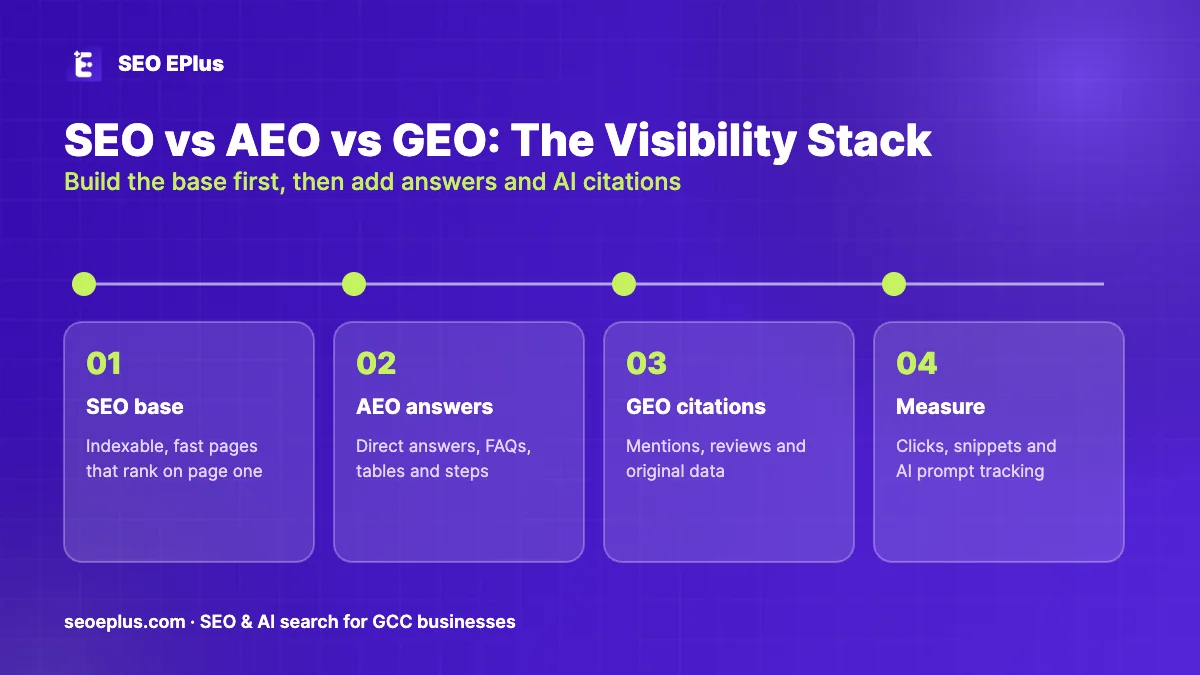
Notice how the rows build on each other. You rarely win an answer box without ranking on page one, and AI tools often draw from pages that already rank well and are widely referenced. That is why we treat SEO vs AEO vs GEO as a stack, not a choice.
What Does Google Say About AEO and GEO?
On SEO vs AEO vs GEO, Google’s position is clear: there is no separate rulebook for AI search. Its official guide on optimizing for generative AI features treats AEO and GEO as part of SEO.
Here are the main points from Google Search Central documentation that matter for the SEO vs AEO vs GEO discussion:
- No extra requirements: there are no additional technical requirements to appear in AI Overviews or AI Mode beyond being indexed and snippet-eligible.
- No special files: you do not need llms.txt or other “AI text files” for Google Search, and Google says it ignores them.
- No special schema: there is no special structured data for AI features. Structured data still helps classic rich results, but it must match visible content.
- Query fan-out: AI Mode and AI Overviews may run several related searches across subtopics, which can surface a wider set of pages than a single query.
- Same controls: nosnippet, data-nosnippet, max-snippet and noindex control how your content appears. Google-Extended relates to Gemini model training and grounding, not to Search ranking.
- Same reporting: clicks and impressions from AI features are counted in the Search Console Performance report under the “Web” search type.
Google also warns that mass-producing pages just to target fan-out queries can break its scaled content abuse policy. In other words, the old shortcuts do not become safe because they have a new name. Recent updates such as the November 2026 core update keep rewarding original, helpful pages over thin ones.
One honest caveat: Google speaks only for Google. ChatGPT, Perplexity and other assistants use their own retrieval systems and partners. The good news is that the same qualities that work on Google, such as clear answers, real expertise and strong authority, also tend to help on other platforms.
What Does the Research on GEO Actually Show?
The research shows that content changes can lift visibility inside AI answers, but results vary by topic. That is the most useful, and most often skipped, part of the SEO vs AEO vs GEO story.
In the original GEO paper, the authors built a benchmark of queries across many domains and tested ways to rewrite source content. They reported that GEO methods could boost visibility in generative engine responses by up to 40%. They also found that the impact depends on the domain, which means no single trick works everywhere.
The methods they tested included adding citations to credible sources, adding quotations and adding statistics, alongside style changes like more fluent or more authoritative writing. For a business, the lesson is simple: give AI systems something worth quoting. Vague marketing copy rarely gets cited. Specific facts, clear definitions and named sources do.
Treat bold claims you see online with care. Many “GEO statistics” come from vendors selling AI visibility tools. When a number matters to your budget, look for the original study and check how it was measured.
Where SEO, AEO and GEO Overlap
Most of the SEO vs AEO vs GEO work overlaps. In our experience, roughly the same core actions improve rankings, answer selection and AI citations at the same time.
- Crawlable, indexable pages: fast, mobile-friendly pages with clean HTML. If Googlebot cannot read it, no AI feature built on Google Search will use it.
- Clear answers early: a direct answer in the first 100 words and at the start of each section.
- Question-based headings: headings that mirror what people ask, so systems can match a section to a query.
- Original expertise: real examples, prices, timelines and lessons from your own work, not rewritten competitor content.
- Entity clarity: consistent company name, address, phone and services across your site, Google Business Profile and directories.
- Authority and mentions: links and brand mentions from trusted local and industry sites.
- Freshness: visible update dates and content that reflects 2026, not 2021.
If you want a structured way to check these, our AI SEO audit checklist walks through each item page by page.
Where SEO vs AEO vs GEO Strategies Differ
The SEO vs AEO vs GEO differences are in focus and measurement, not in fundamentals. Each discipline adds a few habits on top of the shared base.
SEO-Specific Work
SEO still owns keyword research, site architecture, internal linking, technical fixes, link building and conversion-focused landing pages. It is also where you measure revenue, because classic organic clicks are still the main source of trackable leads for most businesses.
AEO-Specific Work
AEO focuses on formatting. Write a 40-60 word answer under each question heading. Use numbered steps for processes and tables for comparisons. Add a real FAQ section for common questions. Learn more about earning the top summary in our guide on how to appear in Google AI Overviews.
GEO-Specific Work
GEO focuses on reputation beyond your website. AI tools form opinions from many sources: reviews, news, directories, forums and comparison articles. So GEO includes digital PR, getting listed in trusted “best of” lists, keeping your brand facts consistent, and publishing original data others want to reference. It also means tracking prompts, not just keywords, for example “best SEO agency in Doha for real estate”.
How to Measure SEO, AEO and GEO Results
Measure each layer of SEO vs AEO vs GEO with its own KPI, but tie all of them to leads. Visibility without enquiries is not a business result.
- SEO: Search Console impressions, clicks and average position; organic sessions and conversions in GA4.
- AEO: featured snippet and “People also ask” ownership for target questions; AI Overview appearances checked manually or with a rank tracker that supports them.
- GEO: a fixed list of 20-50 buyer prompts tested monthly in ChatGPT, Gemini, Perplexity and AI Mode; count brand mentions and cited URLs; track referral traffic from AI domains in GA4.
Keep the prompt list stable so month-to-month numbers are comparable. AI answers change often, so look at trends over several months rather than reacting to one result.
SEO vs AEO vs GEO for Businesses in Qatar and the GCC
For Gulf businesses, the SEO vs AEO vs GEO decision has a local twist: bilingual search and strong mobile use. Many buyers search in both Arabic and English, often by voice, so you need clear answers in both languages.
Here is how the three layers can look in practice. These are illustrative scenarios, not client results:
- A clinic in Doha: SEO targets “dental implants Doha”; AEO answers “how much do dental implants cost in Qatar” with a clear price range section; GEO builds reviews and listings so AI tools recommend the clinic by name.
- A real estate broker in Dubai: SEO ranks area guides; AEO answers “can foreigners buy property in Dubai” in two sentences; GEO earns mentions in property news and comparison sites.
- An e-commerce store in Riyadh: SEO optimizes category pages; AEO adds sizing and delivery FAQs; GEO keeps product facts, prices and return policies consistent across marketplaces.
Local signals matter in all three parts of SEO vs AEO vs GEO. A complete Google Business Profile, consistent NAP details and Arabic content that is written, not machine-translated, help people and AI systems trust you.
A 90-Day Plan to Combine SEO, AEO and GEO
The best SEO vs AEO vs GEO plan starts with the foundation, then layers the extras. This sequence works for most small and mid-sized companies.
- Days 1-30, fix the base: run a technical audit, fix indexing and speed issues, map one keyword per page, and set up Search Console and GA4 conversions.
- Days 31-60, answer better: rewrite your top 10 pages with direct answers, question headings, tables and FAQs; add internal links between related pages.
- Days 61-90, build reputation: collect reviews, clean up directory listings, pitch one data-led story to local media, and start your monthly AI prompt tracking.
If you prefer a team to run this for you, our SEO services for GCC businesses combine classic SEO with AI search optimization in one monthly plan.
Common Mistakes to Avoid
The biggest SEO vs AEO vs GEO mistake is chasing AI search with tricks while ignoring the basics. Watch out for these:
- Treating GEO as a replacement for SEO and cutting technical and content work.
- Publishing hundreds of thin AI-written pages to target every possible question.
- Adding llms.txt files or special markup and expecting Google AI features to reward them.
- Measuring AI visibility once and drawing conclusions from a single answer.
- Ignoring Arabic search and voice queries in Gulf markets when planning SEO vs AEO vs GEO.
Key Takeaways
- SEO vs AEO vs GEO is a stack, not a choice: SEO is the base, AEO formats answers, and GEO builds citations and mentions.
- Google treats optimizing for AI Overviews and AI Mode as SEO, with no special files or schema required.
- Research shows GEO tactics can raise AI visibility by up to 40%, but results vary by topic.
- Clear answers, original expertise, entity consistency and authority help all three.
- Measure each layer separately, but judge success by leads and sales.
Frequently Asked Questions
What is the main difference in SEO vs AEO vs GEO?
SEO aims to rank pages and earn clicks in search results. AEO aims to have your content chosen as the direct answer in snippets, voice and AI Overviews. GEO aims to have your brand mentioned and cited inside AI-generated answers from tools like ChatGPT, Gemini and Google AI Mode.
Is GEO replacing SEO in 2026?
No. AI answer engines still rely on indexed, trusted web content, and Google says optimizing for its AI features is still SEO. GEO adds habits on top of SEO; it does not replace it.
Do I need llms.txt or special schema for AI search?
Not for Google. Google Search Central says you do not need llms.txt or special structured data to appear in AI Overviews or AI Mode. Other AI platforms may behave differently, so focus first on clear, crawlable, helpful content.
How long do AEO and GEO take to show results?
AEO can work within weeks for pages that already rank on page one. GEO usually takes longer because it depends on authority and brand mentions across the web. Track results monthly over at least three months.
Should a small business in Qatar invest in SEO, AEO or GEO first?
Start with SEO, because in SEO vs AEO vs GEO it powers the other two. Once your key pages are indexed and ranking, add AEO formatting to them and build GEO signals such as reviews, listings and local media mentions.
Get Visible on Google and AI Search
Want to know where your business stands on SEO vs AEO vs GEO today? SEO EPlus helps companies in Qatar and across the Gulf turn visibility on Google and AI tools into real enquiries. Contact our team for a free consultation or message us on WhatsApp at +974 7405 3509.